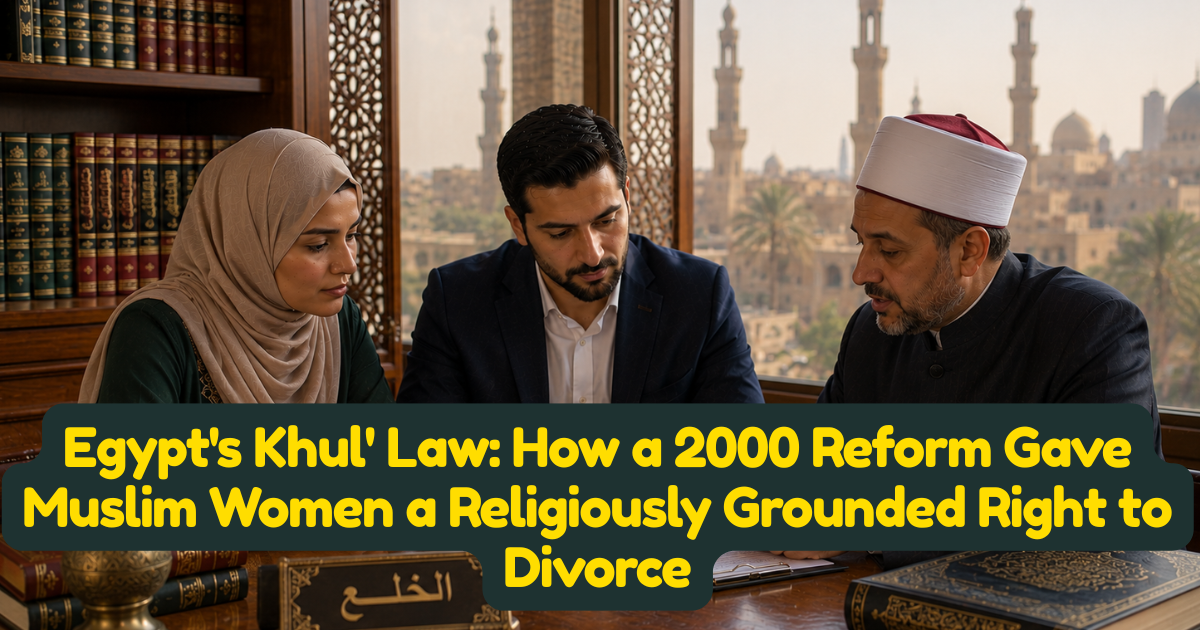
Khul' in Egypt: The 2000 Reform That Changed Who Holds the Power to End a Marriage
Before January 2000, an Egyptian Muslim wife who wanted a divorce her husband refused to grant faced an uphill, often years-long legal battle: she had to prove specific harm — abuse, abandonment, a husband's polygamy without justification — to a court, against a husband who could simply deny the allegations and contest the case indefinitely. A single piece of legislation changed that calculation fundamentally, by reviving and formalizing an ancient Islamic legal mechanism: khul'.
What Khul' Is, and Why It's Different From Ordinary Judicial Divorce
Khul' is a recognized concept within classical Islamic jurisprudence — a wife's right to dissolve her marriage unilaterally by returning her mahr or otherwise compensating her husband, without needing to prove fault or harm on his part. According to Human Rights Watch's detailed report on women's access to divorce in Egypt, the historic problem was not that khul' was unknown to Islamic law — it was that, prior to 2000, the procedure required full judicial discretion and could be drawn out for years, with no guarantee of resolution regardless of how clearly the wife established her case.
What the 2000 Personal Status Law Actually Changed
On January 29, 2000, Egypt's President Mubarak signed legislation that fundamentally restructured this. According to the same Human Rights Watch report, the new law granted women the right to file for divorce on the basis of simple "incompatibility," without needing to provide evidence of harm — provided she was willing to forfeit her financial rights, principally by returning her dower (mahr) and waiving claims to alimony. Academic research published through a detailed scholarly study on courts and personal status law reform in Egypt describes the legal mechanism precisely: a wife's declaration that she "detests living with her husband, that continuation of married life between them has become impossible," and that she fears transgressing "the limits of God" if compelled to remain married, is by itself sufficient — the judge has no discretionary power to deny the request, even over the husband's explicit objection.
The Constitutional Challenge That Confirmed the Law's Validity
The reform faced significant legal challenge almost immediately, including from religious conservative groups who argued it improperly removed the husband's consent from the marriage-dissolution process. According to the same academic study, Egypt's Supreme Constitutional Court reviewed and upheld the khul' law's constitutionality in 2002, drawing on Article 2 of Egypt's 1971 Constitution — the provision establishing Islamic Sharia as a principal source of legislation — to confirm that the reform was not merely compatible with Islamic law but was itself a recognized application of classical khul' doctrine, simply codified into an accessible, judicially efficient civil procedure.
The Trade-Off the Law Imposes — And Why It Matters
This is the aspect of khul' most often misunderstood by people unfamiliar with its mechanics. According to detailed academic analysis from a doctoral study published via a peer-reviewed study on khul' divorce, public debate, and judicial practice in Egypt, the law is explicitly structured as a trade: a wife gains the unilateral, no-fault right to end the marriage, but in exchange forfeits the financial protections — alimony, the marital home, ongoing maintenance — she would otherwise have been entitled to under fault-based divorce. This creates a genuinely difficult calculation for many women: financial security on one side, freedom from an unwanted marriage on the other, with the law deliberately refusing to let her have both simultaneously.
What the Actual Research Shows About Its Effects
Beyond the legal mechanics, rigorous empirical research has examined what khul' actually changed in practice. A peer-reviewed study published in the Journal of Development Economics, hosted on ScienceDirect, used a difference-in-differences design comparing women more and less affected by the reform, and found that the introduction of khul' measurably decreased domestic abuse and increased investment in children's education — interpreting these findings through the lens of "credible divorce threats": once a wife genuinely could leave the marriage unilaterally, husbands' incentive to mistreat her, expecting she had no real exit option, meaningfully declined.
The Implementation Gap: Where the Law's Promise Met Judicial Resistance
The law's formal text and its lived reality have diverged in important, well-documented ways. The same Human Rights Watch investigation found that despite the statute's clear, mandatory language, judges frequently imposed informal financial pressure and bureaucratic delay during khul' proceedings — quoting one Egyptian women's rights advocate observing that "rather than trying to resolve issues between the couple, they try to put pressure on the woman to drop the case." Even Mona Zulficar, an attorney who personally helped draft the 2000 reforms, acknowledged real implementation problems persisted years after passage. Still, the reported numbers show the law functioning at real scale: more than 2,500 khul' cases were resolved within just the first two years of the law's existence.
What This Means for the Broader Conversation About Khula
For Muslim women anywhere navigating the difference between khula (as the term is generally used in South Asian and diaspora contexts) and judicial divorce, Egypt's experience offers a genuinely useful real-world case study of both the promise and the practical limits of codifying a no-fault, wife-initiated divorce right into civil procedure. It demonstrates that a jurisdiction's underlying religious-legal tradition is not, by itself, an obstacle to making such a right meaningfully accessible — the obstacles that remain tend to be implementation and judicial culture, not the absence of doctrinal basis within Islamic law itself.
The Lesson for Drafting a Nikah Contract Today
Couples drafting a nikah contract anywhere — including in Western countries with no equivalent statutory khul' mechanism — can draw directly on this same classical doctrine by including an explicit khul' clause specifying agreed terms in advance: what financial trade-off, if any, would apply if the wife exercises this right, and what process would govern it. Doing so essentially imports, by private agreement, the same protective mechanism Egypt eventually codified into national law — without needing to wait for legislative reform that may never arrive in a given country.
Admin User
Author