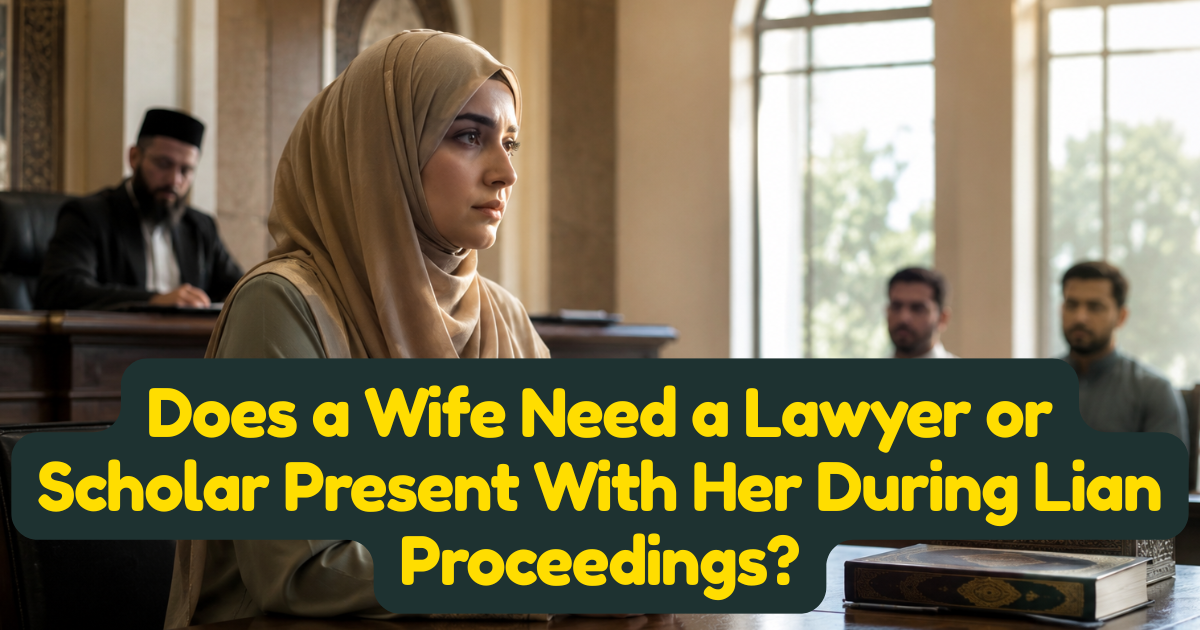
Lian is never something two spouses simply work out between themselves — it has always required a judge's direct involvement. But a formally judge-supervised process is a different thing from a wife having her own independent advocate present specifically to support and represent her interests. Given how rare lian actually is in modern practice, there's limited specific guidance addressing this exact question, but the broader principles governing Sharia council representation, combined with lian's own structural requirements, point toward a reasonably clear answer.
Lian Already Requires Judicial Supervision — But the Judge Isn't Her Advocate
A detailed classical description of public imprecation (al-li'an), drawn from The Reliance of the Traveler, confirms the procedure is directed throughout by an Islamic magistrate or equivalent authority — instructing each spouse on the precise wording, warning them of the gravity of a false oath before the final testimony, and overseeing the entire exchange. This judicial presence is built into lian itself; it isn't optional. But a judge's role here is to conduct the proceeding fairly and correctly, not to represent or advocate for either spouse individually — which leaves open the separate, genuinely practical question of whether the wife should additionally have someone there specifically on her side.
What Broader Sharia Council Practice Suggests
Written evidence submitted to the UK Parliament's inquiry into Sharia councils offers a useful comparison point. According to evidence on Sharia councils submitted to that inquiry, the Muslim Arbitration Tribunal — the highest-profile Sharia forum operating formally under the Arbitration Act — always includes a barrister or solicitor of England and Wales sitting alongside a Scholar of Islamic Sacred Law as part of the tribunal itself, specifically to ensure proceedings meet proper legal standards alongside religious ones. This reflects a broader, increasingly recognised principle in how Islamic family law matters are handled in diaspora contexts: religious authority and legal expertise are treated as complementary, not interchangeable, particularly in proceedings carrying serious or irreversible consequences.
Why Independent Advice Is Genuinely Advisable Here
A general overview of Shariah family law and divorce expertise emphasises that specialist family lawyers familiar with the nuances of Islamic marriage and divorce play a genuinely important role in helping people navigate exactly the kind of high-stakes, religiously and legally complex situations lian represents — irrevocable marital dissolution, paternity rulings with permanent inheritance consequences, and potential corporal punishment liability for false accusation are not matters where either spouse benefits from facing the process without informed support.
What This Means Practically for a Wife Facing Lian
- The judge's involvement is mandatory and built into the procedure itself — but this supervision exists for procedural correctness, not as a substitute for her own representation.
- An independent scholar she trusts, separate from the presiding authority, can help her understand exactly what each oath means, what's at stake, and whether the process is being conducted correctly.
- Given the severity and irreversibility of lian's consequences, seeking independent legal advice beforehand — particularly regarding any civil law dimension of the marriage — is a sensible precaution rather than an unnecessary formality.
- Because lian is so rarely invoked, a wife facing this situation should specifically seek out a scholar or legal advisor with genuine familiarity with the procedure, rather than general family law guidance alone.
Key Takeaway
Lian inherently requires a judge or qualified Islamic authority to direct the proceeding, but that supervisory role isn't the same as a wife having her own independent advocate. Broader Sharia council practice — particularly tribunals that pair legal professionals with religious scholars — reflects a sound underlying principle that applies just as strongly here: given how serious and permanent lian's consequences are, a wife is genuinely well served seeking her own independent scholarly and, where relevant, legal advice before and during the process, even though it isn't always formally mandated as part of lian itself.
```Admin User
Author