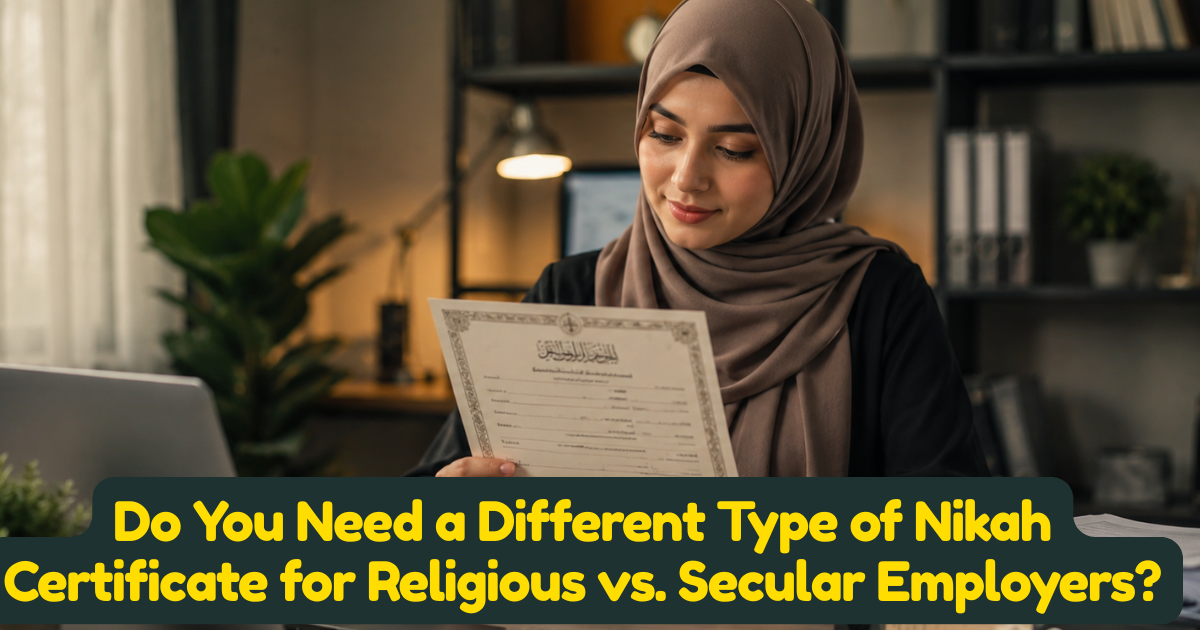
Do You Need a Different Type of Nikah Certificate for Religious vs. Secular Employers?
Couples navigating both religious community life and secular workplace administration sometimes wonder whether they'll need two separate versions of their marriage documentation — one satisfying a mosque or religious institution's expectations, another meeting a secular employer's benefits or HR requirements. The good news is that, in the great majority of cases, a single properly issued certificate serves both purposes without needing to be duplicated or reformatted.
What a Religious Institution Typically Wants to See
A mosque, Islamic school, or religious community organization asking to confirm a couple's marital status generally wants confirmation that a valid nikah took place — the date, the officiant's credentials, and confirmation that Islamic conditions (witnesses, mahr) were properly met. A standard, well-documented nikah certificate from a certified officiant or service fully satisfies this need without requiring any special religious-specific formatting beyond standard, accurate documentation.
What a Secular Employer Typically Wants to See
An employer's HR department processing a benefits enrollment, updating records, or verifying eligibility for a marriage-related workplace policy generally wants documentation confirming the marriage occurred, including the names of both spouses, the date, and some form of official verification. Whether they require a religious certificate, a civil marriage certificate, or either as acceptable proof depends entirely on the employer's specific policy and, relatedly, on whether your religious ceremony also satisfies civil registration requirements in your jurisdiction.
Why the Real Distinction Is Religious Versus Civil, Not Religious Versus Secular
This is the clarification that resolves most of the confusion: the meaningful distinction isn't between a "religious institution version" and a "secular employer version" of the same document, but between a religious (nikah) certificate and a civil marriage certificate, as covered in our dedicated article on this broader distinction. Most secular employers, particularly larger organizations with formal HR policies, ultimately want civil marriage documentation for official benefits and tax purposes, not specifically a religious certificate, though smaller employers or those in countries where religious and civil marriage are unified may accept either.
When Your Nikah Certificate Alone Satisfies Both Needs
In jurisdictions where your officiant is registered as an authorized civil marriage officer, or where a country doesn't require separate civil registration at all, a single nikah certificate can serve both the religious community's needs and a secular employer's documentation requirements, since it functions as your complete, officially recognized marriage record in that context.
When You'll Likely Need Both a Nikah Certificate and Separate Civil Documentation
In jurisdictions where civil and religious marriage are entirely separate processes — as is the case in most of the countries covered throughout our country guides — you'll generally want both documents on hand: your nikah certificate for religious community purposes, and your civil marriage certificate for employer HR departments, tax authorities, and other government-facing needs. This isn't a special "employer version" of your nikah certificate; it's simply the separate civil document your specific country requires alongside your religious one.
What to Do If Your Employer Isn't Familiar With Islamic Marriage Documentation
Some HR departments, particularly in regions with smaller Muslim populations, may be unfamiliar with what a nikah certificate represents and how it relates to formal civil marriage recognition. In these cases, providing your civil marriage certificate (where you have one) is generally the more straightforward path, since it will be immediately recognizable in a format the HR department already understands, without needing to explain the nikah's separate religious significance in that specific administrative context.
Translated Certificates for International Employers
For couples whose certificate was issued in a language other than their employer's primary working language, a certified translation may be needed regardless of whether the underlying document is religious or civil — this is a language and jurisdiction consideration, not evidence that a fundamentally different type of certificate is required for employer purposes specifically.
Certificate Formatting That Supports Broad Acceptance
A well-structured nikah certificate — clearly stating both spouses' full legal names matching government identification, the date, officiant credentials, and witness details — is generally readable and acceptable to a wide range of institutions, religious or secular, without needing multiple differently formatted versions produced for different audiences. Clarity and completeness matter more than producing separate, audience-specific document variants.
Requesting Additional Copies or Formats
If a specific institution, religious or secular, has an unusual formatting requirement your standard certificate doesn't meet, most certified services, including ours, can typically accommodate a reasonable formatting request or provide an additional certified copy, rather than needing to produce an entirely separate document type from scratch.
How InstantNikah.com Structures Certificates for Broad Use
We issue nikah certificates designed for clarity and broad institutional acceptance from the outset, and we clearly explain to every couple whether their certificate also satisfies civil registration in their specific country or whether separate civil documentation will be needed alongside it for employer, government, or other secular administrative purposes.
Admin User
Author