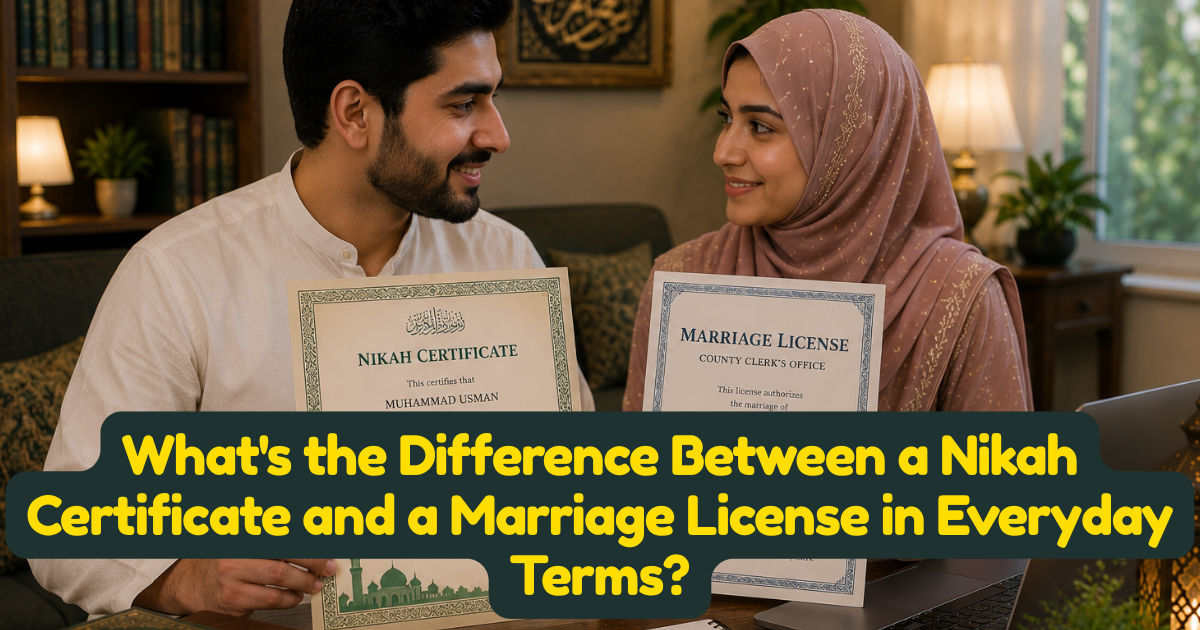
What's the Difference Between a Nikah Certificate and a Marriage License in Everyday Terms?
If you've spent any time navigating marriage documentation as a Muslim couple, you've probably come across both terms — nikah certificate and marriage license — sometimes used almost interchangeably by well-meaning family or friends, which understandably creates confusion. They're actually two different things, issued by two different types of authority, and understanding the distinction clearly saves a lot of confusion down the line.
The Nikah Certificate: A Religious Document
A nikah certificate is issued by a religious officiant — an imam, qazi, or certified Islamic marriage service — documenting that an Islamic marriage contract was properly performed: the offer and acceptance, the witnesses present, the mahr agreed upon, and any conditions attached to the contract. It confirms your marriage in the eyes of Islamic law and your religious community. On its own, in most countries, it does not carry automatic legal weight with government authorities.
The Marriage License or Certificate: A Government Document
A marriage license (sometimes obtained before the ceremony, authorizing it to take place) and the resulting marriage certificate (issued after registration) are government documents, issued by a civil authority — a registrar's office, vital statistics office, or equivalent body depending on your country. This is what makes your marriage legally recognized for purposes like taxes, inheritance under civil law, spousal benefits, and immigration.
Why Both Often Matter for Muslim Couples
As covered throughout our country guides, most jurisdictions treat these as entirely separate processes — a nikah certificate alone typically doesn't register your marriage with the government, and a civil marriage license alone doesn't fulfill Islamic religious requirements. Couples who want their marriage recognized both religiously and legally generally need both documents, obtained through their respective, separate processes.
Can One Document Ever Serve Both Purposes?
In some places, yes — where an imam is specifically registered by the government as an authorized marriage officiant, a single ceremony can produce documentation that satisfies both religious and civil requirements simultaneously. This isn't universal, though, and depends entirely on your specific officiant's registration status and your country's laws, which is why confirming this specifically with your officiant matters rather than assuming it applies.
What Each Document Is Typically Used For
- Nikah certificate: confirming religious marital status to your mosque or community, supporting a Sharia council process if ever needed, and serving as the religious record of your mahr and any contract conditions.
- Marriage license/certificate: tax filing status, spousal visa or immigration sponsorship, name changes on government identification, inheritance under civil law, and any legal proceeding involving your marital status.
What Happens If You Only Have One
Having only a nikah certificate without civil registration means you're religiously married but not legally recognized as married by your government — this can create real complications for tax status, immigration sponsorship, or inheritance under civil law. Having only a civil marriage license without a nikah means you're legally married but haven't fulfilled the Islamic conditions many Muslim couples consider essential to their marriage being complete in the eyes of their faith.
Keeping Both Documents Safe and Accessible
Since each document serves different purposes and different authorities may request one or the other, keeping both in a safe, accessible location — along with digital backups — ensures you're never caught without the specific document a given situation requires.
How InstantNikah.com Helps Couples Understand Both
We always explain clearly, before any ceremony, whether the nikah certificate we issue also satisfies civil registration in the couple's specific country, or whether a separate civil marriage process is still needed — ensuring couples leave the consultation understanding exactly what they have and what, if anything, remains to be completed.
Admin User
Author