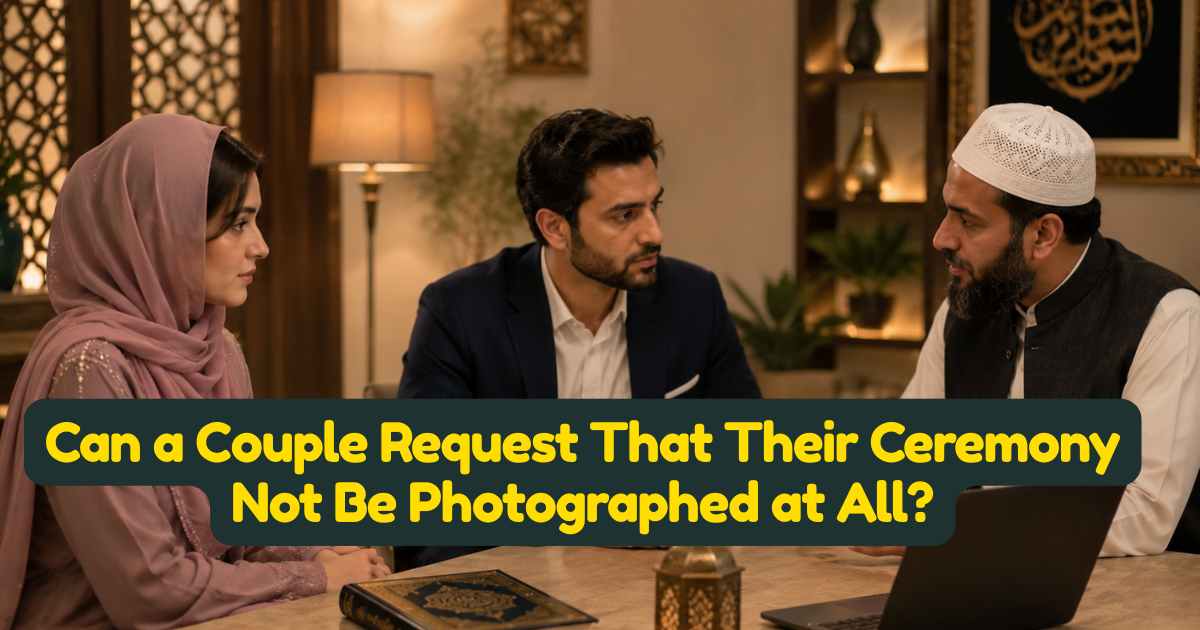
Can a Couple Request That Their Ceremony Not Be Photographed at All?
Not every couple wants their nikah documented visually, even for their own private keeping. Whether rooted in a preference for modesty, a desire to keep the moment entirely between those present, past experience with unwanted image sharing, or simply personal temperament, some couples want assurance that no photos or recordings will be taken during their ceremony at all — and it's worth confirming clearly that this is entirely within their right to request.
Photography Is Never a Requirement of a Valid Nikah
Nothing about the nikah's validity depends on visual documentation of any kind — the marriage is established through the properly witnessed offer and acceptance, not through photographic evidence of the event. A couple can have a fully valid, properly documented (in the written certificate sense) marriage with zero photographs or recordings ever taken during the ceremony itself.
Distinguishing the Certificate From Photography
It's worth clarifying an important distinction: the written nikah certificate, documenting the marriage's terms, witnesses, and officiant, is entirely separate from visual photography or video recording of the ceremony itself. A couple can decline all photography while still receiving a complete, properly issued written certificate — these are not linked requirements, and declining one has no bearing on receiving the other.
Why Some Couples Prefer No Photography
- Modesty preferences, particularly for a bride who observes niqab or simply prefers her image not be captured, even for private keeping, during this significant moment.
- Privacy and safety concerns, especially relevant for couples in sensitive situations, such as those navigating family opposition, prior experiences of image misuse, or circumstances where visual documentation could pose a genuine risk if it were ever to be seen by the wrong person.
- Simply personal preference, wanting the moment to exist purely in memory rather than as a captured, potentially permanent image or recording.
- Discomfort being photographed generally, independent of the specific occasion, which some individuals feel regardless of the context.
How This Request Should Be Communicated and Honored
Couples wanting no photography or recording at all should communicate this clearly to their officiant and to any guests joining the call, ideally in advance rather than in the moment itself, so everyone present understands and respects this preference from the outset rather than needing to be corrected mid-ceremony after someone has already taken a photo.
Setting Clear Expectations With Online Guests
For an online ceremony specifically, this means explicitly asking guests joining the video call not to take screenshots, record their screen, or otherwise capture images from the call — while acknowledging honestly, as discussed in our broader article on livestream privacy, that a couple can request this clearly but cannot fully guarantee compliance from every guest once content is displayed on someone else's screen, which is worth factoring into the decision about how many, and which, guests to invite to a ceremony where this level of privacy matters significantly.
Does the Officiant or Service Ever Retain Recordings
Couples wanting no recording at all should confirm directly with their service whether the ceremony itself is recorded for internal purposes (such as verification or dispute-resolution backup) even if not shared with guests, and should feel entirely comfortable requesting that no such internal recording occurs either, if that's their genuine preference — a service respecting this request should honor it fully rather than recording anyway for its own separate purposes without the couple's knowledge or consent.
What This Means for Family Wanting to "See" the Ceremony Afterward
Family members who couldn't attend the live ceremony and hoped to see photos or a recording afterward should be informed clearly, ideally by the couple themselves, that this particular ceremony was kept entirely private and undocumented visually by the couple's own choice — this is a reasonable boundary to communicate and hold, even if it means disappointing some family expectations.
Separating the Ceremony From a Photographed Celebration Afterward
Some couples who prefer no photography during the nikah itself still choose to have photos taken during a separate walimah or celebratory gathering afterward, allowing them to maintain full privacy around the specific contractual ceremony while still capturing images of the broader celebration if they're comfortable with that. This is a reasonable way to honor both the desire for privacy around the nikah specifically and a wish to have some visual memories of the wider occasion.
Why This Preference Deserves Full Respect, Without Requiring Justification
Couples requesting no photography shouldn't feel obligated to justify or explain this preference extensively — whether the reason is modesty, safety, or simply personal temperament, wanting to keep this moment private is a completely legitimate choice that a respectful service should accommodate without pushing back or treating the request as unusual.
How InstantNikah.com Honors No-Photography Requests
We fully respect and accommodate any couple's request for no photography or recording of their ceremony, ensuring our own process involves no retained visual documentation beyond the standard written certificate, and helping couples communicate this preference clearly to any guests joining the call ahead of time.
Admin User
Author