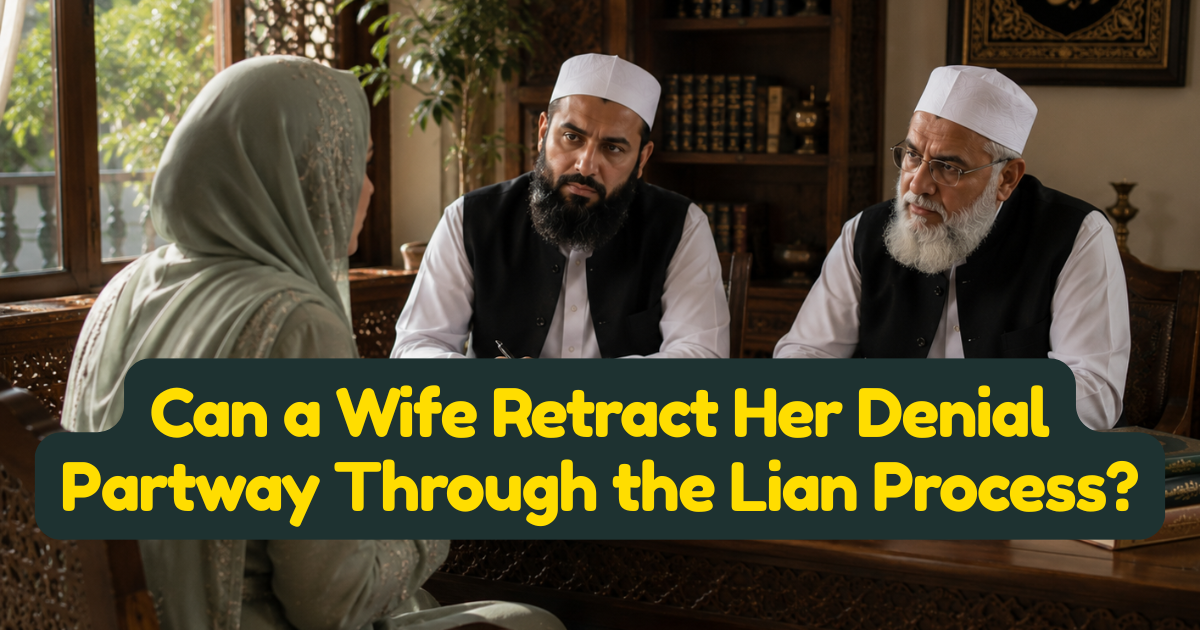
Once a husband has sworn his side of the lian oaths, his wife faces her own solemn five-part testimony to avert the punishment for adultery. It's a genuinely heavy moment, and it's entirely understandable that a wife might hesitate, falter, or stop partway through. What happens in that moment — whether she's simply imprisoned until she completes it, or treated as having effectively confessed — is something the classical schools of Islamic law actually disagree about.
The Core Disagreement: What Does Stopping Actually Mean?
A detailed comparative explanation of the Islamic legal procedure following an accusation of adultery lays out the genuine scholarly split here. If the wife refuses to swear the prescribed oaths in the proper manner, Abu Hanifah's position is that she should simply be imprisoned until she completes them — treating her hesitation as a procedural delay rather than an admission. Al-Shafi'i, the Shafi'i school, and Malik take a meaningfully different view: a wife who refuses to complete her oaths should instead face the punishment for adultery directly, on the reasoning that her failure to deny the accusation, once her husband has sworn his side, functions as an effective concession that the accusation was true.
Why This Distinction Genuinely Matters
This isn't a minor procedural footnote — it determines whether a wife who stops partway through is treated as someone simply struggling with an enormously difficult moment, or as someone who has, by that act alone, conceded the truth of a serious accusation. A detailed academic explanation of li'an's Quranic basis and consequences reinforces why the stakes are so high either way: the entire mechanism exists specifically to resolve an otherwise irresolvable accusation through solemn oath rather than ordinary evidence, which is precisely why an incomplete oath carries such serious weight under either scholarly position — there's no middle ground where a partial attempt is simply disregarded.
What "Retracting" Actually Looks Like in Practice
- Genuinely stopping or refusing to continue — under the Hanafi view, this leads to continued detention until she either completes the oaths or admits the accusation; under the majority view, it can be treated as functionally conceding the accusation and exposes her to the corresponding punishment.
- Completing the oaths despite hesitation — wavering or visible distress during the process doesn't itself invalidate a properly completed oath; what matters is whether she ultimately finishes the full five-part testimony as prescribed.
- Openly confessing partway through is a different scenario from simply stopping — a genuine confession is treated as an admission in its own right, regardless of which school's procedural framework applies to mere refusal.
- The judge's role matters here too — the process is meant to be conducted under the direction of an Islamic judge specifically because these distinctions between hesitation, refusal, and confession require careful, qualified judgment rather than a rigid rule applied mechanically.
Why This Reinforces How Seriously Lian Should Be Approached
This genuine disagreement between the schools is itself a signal of how seriously Islamic law treats every stage of this process. There's no scenario in which a wife can begin the lian oaths and then simply walk away from them without consequence — either she completes them, faces detention until she does, or, under the more severe majority position, is treated as having effectively admitted to the accusation. This is exactly why scholars consistently emphasise that lian should never be entered into lightly by either spouse, and why a wife facing this situation needs careful guidance from a qualified scholar before the process even begins, not partway through it.
Key Takeaway
A wife who hesitates or stops partway through her lian oaths faces genuinely different consequences depending on which school of thought applies — detention until she completes the process under the Hanafi position, or exposure to the punishment for adultery itself under the majority view, which treats her refusal as an effective concession. This disagreement underscores just how solemn and consequential each stage of lian actually is, with no available middle ground once the process has genuinely begun, which is precisely why qualified guidance before starting is so important.
```Admin User
Author