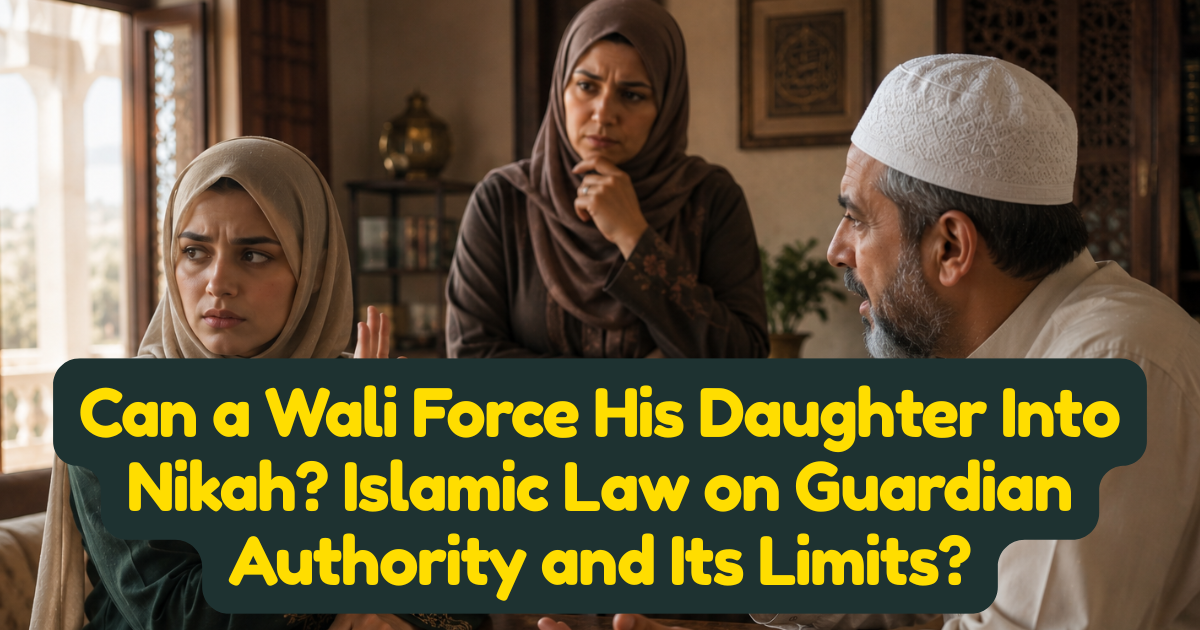
Can a Wali Force His Daughter Into Nikah? Islamic Law on Guardian Authority and Its Limits
There is perhaps no question in Islamic family law that sits at the intersection of faith, culture, and personal freedom more uncomfortably than this one. Across Muslim communities — from South Asia to the Middle East to diaspora communities in Europe and North America — the role of the wali in Nikah has been interpreted, misinterpreted, stretched, and sometimes weaponised in ways that have caused real harm to real women.
The question deserves a clear, honest, and deeply researched answer. Can a wali force his daughter into Nikah? What does Islamic law actually say — not cultural tradition, not family expectation, but Shariah itself?
The short answer is no. The longer answer requires understanding what the wali's authority is, where it ends, and what protections Islamic law has always provided — long before modern human rights frameworks existed.
What Is a Wali, and What Is His Role in Nikah?
The word wali comes from the Arabic root meaning guardian, protector, or ally. In the context of Nikah, the wali is the male guardian — typically the father, then the paternal grandfather, then the brother, and so on down the line of male relatives — whose presence and consent is required for a woman's Nikah to be valid, according to the majority scholarly position.
The Prophet ﷺ is authentically reported to have said: "There is no Nikah except with a wali." (Sunan Abu Dawud, authenticated by al-Albani). This narration forms the basis of the majority opinion across the Shafi'i, Maliki, and Hanbali madhabs that the wali's participation is a pillar of Nikah validity, not merely a formality.
But the role of the wali as defined in classical fiqh is not that of a decision-maker acting unilaterally. It is the role of a protector acting in service of the woman's interests. This distinction — between authority granted in trust and authority exercised as control — is where much of the cultural distortion of this concept has occurred.
The Doctrine of Consent: What the Hadith Explicitly Establishes
The evidence on consent in Islamic marriage is unambiguous. The Prophet ﷺ made it the subject of direct instruction on multiple occasions:
In Sahih al-Bukhari and Sahih Muslim, the Prophet ﷺ stated: "A previously married woman should not be given in marriage without her express consent, and a virgin should not be given in marriage without her consent." The companions asked: "How is her consent expressed?" He replied: "By her silence."
This narration is not simply about silence being acceptable as a form of agreement. It establishes that consent must be sought in the first place — that the question must be put to her, that she must be consulted, that her response (even if non-verbal) must be freely given rather than coerced. The very structure of the narration presupposes a process of genuine consultation.
In another authentic narration collected by Imam Ahmad and others, a woman came to the Prophet ﷺ saying her father had arranged her marriage without her consent. The Prophet ﷺ gave her the choice — she could accept the marriage or have it annulled. She ultimately chose to accept it, saying she only came to establish that fathers do not have unlimited authority over their daughters in this matter.
This narration is extraordinary in its clarity. A Companion-era father arranged a marriage without his daughter's agreement. The Prophet ﷺ did not uphold it automatically simply because the wali had acted. He gave the woman agency over the outcome.
The Four Madhabs on Forced Marriage: Where They Agree and Where They Differ
Classical jurisprudence is nuanced on this question, and the differences between the schools matter practically:
The Shafi'i and Hanbali Position
Both schools recognise the concept of wilayat al-ijbar — a father's ability to contract a Nikah on behalf of his virgin daughter without explicitly seeking her consent. However, this was understood within a specific historical and social context, and was always conditioned on the absence of harm. A father exercising ijbar who was found to have acted against his daughter's clear interests was considered to have acted wrongfully, even under these schools.
Importantly, contemporary Shafi'i and Hanbali scholars have significantly qualified this position. Many no longer apply ijbar in modern contexts where a woman is educated, independent, and capable of full consent — recognising that the social conditions that originally contextualised the ruling no longer apply universally.
The Maliki Position
The Maliki school grants the father a degree of ijbar over a virgin daughter but simultaneously requires that the arrangement not harm her and that she not express clear objection. If she objects meaningfully, the father's unilateral authority is weakened significantly under Maliki jurisprudence.
The Hanafi Position
The Hanafi madhab — which is the dominant school across South Asia, Turkey, and much of Central Asia — takes a markedly different position that is more protective of the woman's autonomy. Under the Hanafi school, a mature woman (one who has reached puberty and is of sound mind) can contract her own Nikah without the wali's participation, provided the prospective husband is of suitable compatibility (kafaah).
This is a significant and often under-discussed aspect of Hanafi fiqh. The Hanafi position effectively means that for the vast majority of the world's Sunni Muslims — given the demographic dominance of Hanafi communities — the wali's consent is not an absolute prerequisite for a valid Nikah of a mature woman. And crucially, the wali has no right to force her into a Nikah she does not want.
The Concept of Adhl: When the Wali Becomes the Obstacle
Islamic jurisprudence recognised — with remarkable foresight — that guardians could abuse their authority in two directions: by forcing an unwanted marriage, or by unjustly preventing a desired one. The latter is addressed by the legal doctrine of adhl, which means unjust prevention or obstruction by the wali.
Allah says in Surah Al-Baqarah (2:232): "Do not prevent them from remarrying their former husbands, if they mutually agree on reasonable terms." Classical scholars, including Imam al-Shafi'i, used this verse as a direct basis for establishing that a wali who unjustly blocks a woman's Nikah loses his guardianship — and the right of guardianship transfers to the next eligible guardian or, ultimately, to the Islamic judge.
The same logic applies in reverse to forced Nikah. A wali who imposes a marriage against a woman's will is not exercising Islamically-sanctioned authority. He is abusing a trust. And Islamic law has always provided a mechanism to address this abuse.
The Sultan as Wali: The Court's Role When Guardians Fail
One of the most practically important — and frequently overlooked — principles in Islamic marriage law is the concept of al-sultan wali man la wali lah: the ruler (or Islamic authority) becomes the wali of the one who has no wali.
The Prophet ﷺ is reported to have said: "The ruler is the guardian of the one who has no guardian." (Sunan Abu Dawud, Sunan al-Tirmidhi).
Classical scholars applied this principle both to women who had no living male relatives and to women whose guardians had behaved in ways that disqualified them from the guardianship role — including through adhl (unjust obstruction) or through attempting to force an unwanted Nikah.
In practical terms today, this means that in Muslim-majority countries with functioning Shariah courts, a woman whose wali is forcing or obstructing her Nikah has recourse to the judiciary. In Muslim-minority countries — such as the UK, USA, Canada, or across Europe — Islamic scholars and online Nikah service providers operate within both religious and civil frameworks to ensure women are not left without options.
Forced Nikah Is Not Only Wrong — It Is Legally Null
Across the major schools of thought, a Nikah contracted under duress — where a party was forced, threatened, or had their genuine will overridden — is either fasid (defective) or void altogether. The Hanafi school holds that a Nikah contracted under coercion is defective and can be annulled. The Maliki and Hanbali positions similarly allow for annulment where coercion is demonstrated.
In contemporary Islamic legal reasoning, this position is absolute. The International Islamic Fiqh Academy — affiliated with the Organisation of Islamic Cooperation — has affirmed that consent is a fundamental pillar of valid marriage in Islam, and that any marriage contracted without genuine, free consent is invalid from an Islamic perspective.
This aligns directly with civil law across most of the world. In the United Kingdom, for instance, forcing someone into marriage — including a religious ceremony — is a criminal offence under the Forced Marriage (Civil Protection) Act 2007 and the Anti-Social Behaviour, Crime and Policing Act 2014. In the United States, forced marriage is prosecutable under various federal and state statutes. Islam and the law, on this particular matter, stand together.
What About Cultural Pressure That Stops Short of Physical Force?
One of the most practically important questions is where the line falls between family influence — which is normal and often valuable — and coercion, which Islamic law prohibits. Scholars have addressed this question with considerable care.
Classical jurisprudence recognised forms of ikrah (coercion) that go beyond physical threats. Psychological pressure, emotional manipulation, threats to family honour, financial threats, and persistent intimidation were all considered by scholars in the category of duress that could affect the validity of a contract. Ibn Qudama al-Maqdisi, the great Hanbali jurist, discussed various forms of coercion in Al-Mughni and established that genuine fear arising from threats — even non-physical ones — constitutes ikrah under Islamic law.
For a Muslim woman who feels pressured by family expectations but is not physically threatened, the Islamic guidance is clear: her Nikah must be her genuine choice, freely made. No Nikah contracted under a state of meaningful pressure — where she would not freely have chosen this arrangement — reflects the Islamic ideal of marriage, regardless of how it may appear outwardly.
The Rights of a Woman When Her Wali Oversteps
Islamic law provides a woman with the following when her wali attempts to force a Nikah:
- The right to refuse. Every school of thought, despite differences in other matters, agrees that a woman's expressed refusal — particularly if she is a previously married woman — carries significant legal weight. Even under the Shafi'i position on ijbar, expressed clear refusal changes the calculus.
- The right to seek transfer of guardianship. If the wali is acting unjustly, guardianship transfers to the next eligible male relative — and eventually to an Islamic authority or court.
- The right to have the forced Nikah annulled. If a Nikah was forced and she can demonstrate this, Islamic courts have consistently provided the mechanism for annulment under the concept of faskh.
- The right to a qualified Islamic scholar or organisation to act as wali. In jurisdictions without accessible family guardians, qualified Islamic scholars can serve as wali — removing the forced dependency on a coercive family member.
How InstantNikah.com Handles Wali, Consent, and Guardian Authority
At InstantNikah.com, every Nikah we facilitate is conducted with full attention to the requirements of Islamic law — including the genuine, free consent of both parties. We do not facilitate Nikahs where consent is in question, where parties appear under pressure, or where the process does not reflect Shariah requirements.
For women who face difficult family situations — including absent, uncooperative, or coercive guardians — we are experienced in providing appropriate Shariah-compliant wali arrangements through qualified Islamic scholars, ensuring that no woman is left without access to a valid Nikah simply because her family has overstepped.
You can learn more about our Nikah process, explore our Nikah packages, or reach us directly through our contact page. If your situation involves guardianship difficulties, our team is experienced in handling these matters with complete discretion and Shariah care.
Conclusion: Authority Is a Trust, Not a Weapon
The wali in Islamic marriage law is a protector. He is given authority not as an ownership right over a woman, but as a responsibility of care — a trust placed by Allah and by Islamic law to ensure her interests are served, not overridden.
A wali who forces his daughter into a Nikah she does not want has not exercised Islamic authority. He has violated it. And Islamic law — classical and contemporary, across all four major schools — provides the principles, the mechanisms, and the scholarly consensus to address exactly that situation.
For Muslim women navigating guardianship challenges, the message of Islamic jurisprudence is this: your consent is not a courtesy. It is a condition. And no cultural norm, family pressure, or misapplication of the concept of wali can remove that right from you under Islamic law.
Admin User
Author