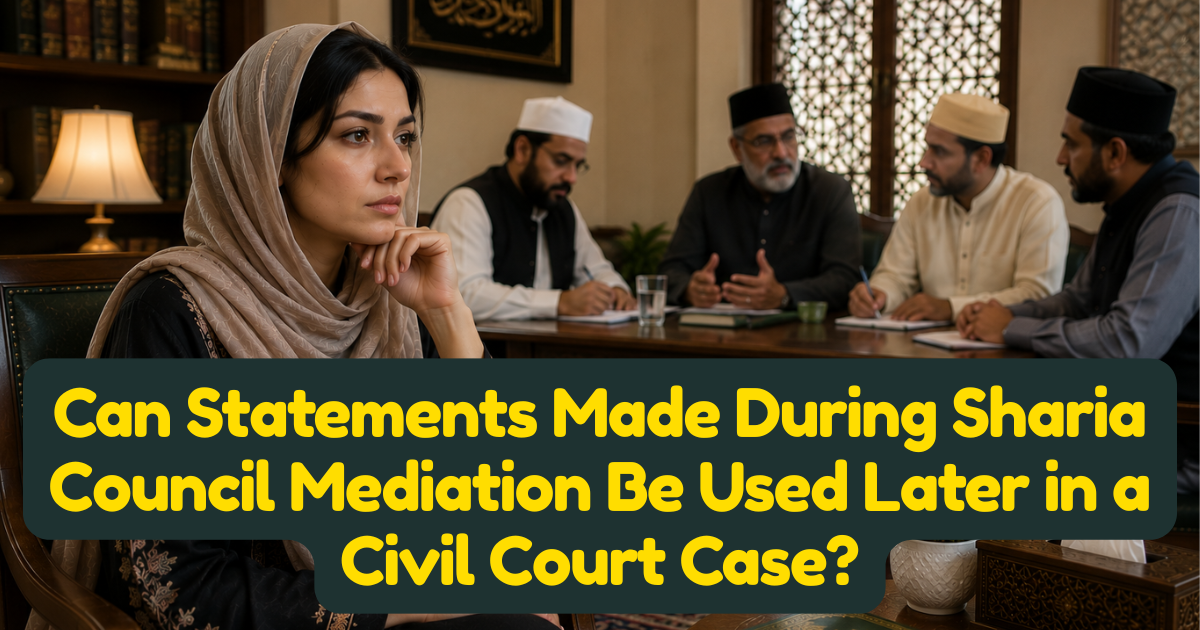
Couples going through Sharia council mediation often speak candidly, assuming — reasonably — that the whole point of mediation is confidentiality, and that nothing said there could later resurface in a civil courtroom. Sharia councils themselves generally do treat their proceedings as confidential as a matter of policy. But whether a civil court would actually recognise and enforce that same protection if a dispute over the statements arose is a genuinely more complicated legal question.
Sharia Councils Treat Their Own Proceedings as Confidential
Written evidence submitted to the UK Parliament's Sharia councils inquiry confirms this is standard council policy. According to evidence on Sharia councils, proceedings are not conducted in public, and the privacy and confidentiality of the couple involved are explicitly respected as a matter of council practice. This addresses the council's own internal conduct — it doesn't, by itself, answer whether a civil court would treat statements made in that setting as legally privileged if one party later tried to introduce them as evidence in separate civil proceedings.
How "Without Prejudice" Privilege Normally Works
In ordinary UK family law practice, this kind of protection has a specific legal basis. A detailed guide to privilege in family law proceedings explains that without prejudice privilege applies specifically to correspondence and discussions genuinely aimed at settling a dispute, and that this protection extends to mediation sessions precisely because they exist for that settlement purpose. Crucially, the guide notes this privilege isn't unqualified — it cannot be used to shield genuine impropriety, and a party can't rely on it to make an admission during mediation and later deny that same fact elsewhere. Separate legal guidance on mediation confidentiality and the without prejudice rule reinforces that this protection generally requires a genuine settlement context — the contractual and formal structure typically built around recognised mediation is part of what makes the privilege apply so clearly in that setting.
Why This Creates Genuine Uncertainty for Sharia Council Mediation
This is exactly where the picture becomes less clear for religious mediation specifically. Without prejudice privilege has traditionally developed around formally structured settlement processes — often with signed mediation agreements, recognised mediators, and a clear contractual framework establishing confidentiality from the outset. A Sharia council's mediation, while genuinely aimed at resolving the dispute and treated as confidential by the council itself, doesn't always carry that same formal legal architecture. Whether a civil court would extend the same protection to statements made in this less formally structured context is a genuinely open question that would likely depend on the specific circumstances — whether the council documented the process as a genuine settlement attempt, whether both parties understood and agreed to confidentiality, and how the statements are ultimately sought to be used.
What This Means Practically for Couples
- Don't assume statements made during Sharia council mediation are automatically protected the same way formal civil mediation would be — the legal basis for that protection is genuinely less certain in this context.
- Avoid treating Sharia council mediation as a consequence-free space to make admissions you wouldn't want raised elsewhere, given this uncertainty.
- If a council documents its mediation process formally — with clear confidentiality terms agreed by both parties — this strengthens (though doesn't guarantee) the case for treating it similarly to other recognised mediation.
- This is genuinely a question for specialist legal advice if a specific situation arises where Sharia council mediation statements might become relevant to separate civil proceedings, rather than something to assume one way or the other.
Key Takeaway
Sharia councils generally treat their mediation proceedings as confidential as a matter of internal policy, but whether a civil court would independently recognise and enforce that same protection through without prejudice privilege is a genuinely uncertain question — one that depends heavily on how formally structured the specific mediation process was, and whether it carried the kind of clear settlement framework that privilege traditionally requires. Couples should treat this as a real area of legal uncertainty rather than assuming automatic protection, and seek specific legal advice wherever this question genuinely matters to their situation.
```Admin User
Author