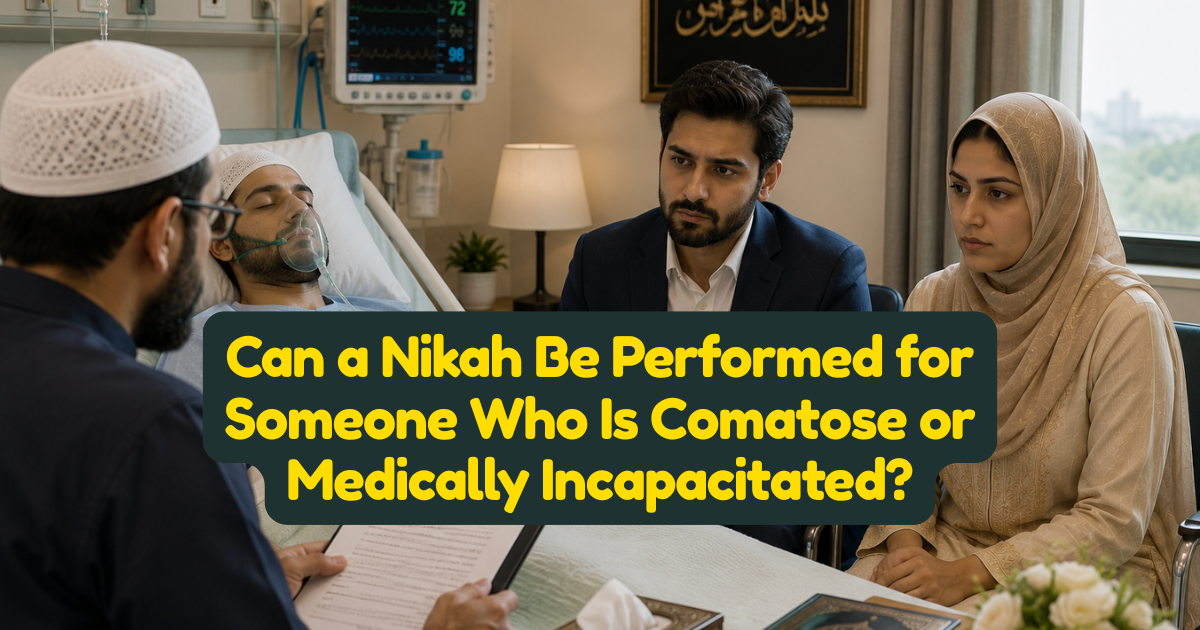
Nikah for an Unconscious or Incapacitated Person: Why Consent Cannot Be Delegated
There's an important distinction many people miss between two scenarios that sound similar: a groom who is simply absent — traveling, deployed, overseas — and a person who is medically unconscious or incapacitated and genuinely unable to consent to anything at all.
The Wakeel Precedent Only Works for Absence, Not Incapacity
Islamic law does permit marriage by proxy in the first scenario. The Prophet ﷺ himself appointed an-Najashi to act on his behalf in marrying Ramlah bint Abu Sufyan while he was not personally present — a precedent confirmed in this classical fiqh ruling collected by Dorar.net's compiled summary of the conditions of a valid marriage contract. A wakeel relays a clear, pre-expressed intention to marry on behalf of someone who is capable of forming that intention but physically unavailable to state it in person.
The Pillar That Doesn't Bend: Free, Conscious Consent
A person in a coma or under deep sedation has not delegated consent — they are incapable of forming or expressing it at all, before or during the contract. Every classical school treats genuine consent of both parties as a non-negotiable condition of a valid marriage contract, distinct from the separate question of wali consent. A foundational academic source on this exact requirement, hosted by Brandeis University's Feminist Sexual Ethics Project, explains that Islamic jurisprudence treats marriage as a civil contract requiring the free, conscious agreement of both parties — a wakeel cannot manufacture consent that was never actually given by an unconscious principal, only relay consent that already exists.
What If the Person Expressed Intent Before Becoming Incapacitated?
This is the one scenario where a nikah involving an incapacitated person could be religiously defensible: if the person clearly and unambiguously expressed their intention to marry a specific individual before losing consciousness — for example, immediately before a scheduled surgery — and formally appointed a wakeel to finalize that specific, already-agreed contract. A detailed Q&A treatment of how a wakeel's authority is strictly limited to the terms the principal actually authorized is available through the Islamic Association of Raleigh's fiqh guidance on valid marriage contracts. Even then, most scholars would require extremely clear, ideally written or witnessed, evidence of that prior intent — not a family member's assumption of what the person "would have wanted."
The Civil Law Runs Into the Identical Wall
Western family law reaches the same conclusion through a different route. According to FindLaw's guide to medical directives and incapacity, even a durable power of attorney for healthcare or finances grants an agent no authority to consent to marriage on the principal's behalf — marriage consent is treated in virtually every jurisdiction as a personal right that cannot be delegated, no matter how comprehensive the power of attorney document is. A medical or financial proxy can make treatment and money decisions for an unconscious person; it cannot marry them.
Why Both Systems Land in the Same Place
Both Islamic jurisprudence and Western civil law converge on an identical underlying principle: marriage is a uniquely personal act of consent that no proxy, however well-intentioned or legally appointed, can supply on someone else's behalf once that person has lost the capacity to consent. The wakeel and the power-of-attorney both have real, legitimate authority — but neither extends into manufacturing a "yes" that the person in question can no longer give.
Admin User
Author