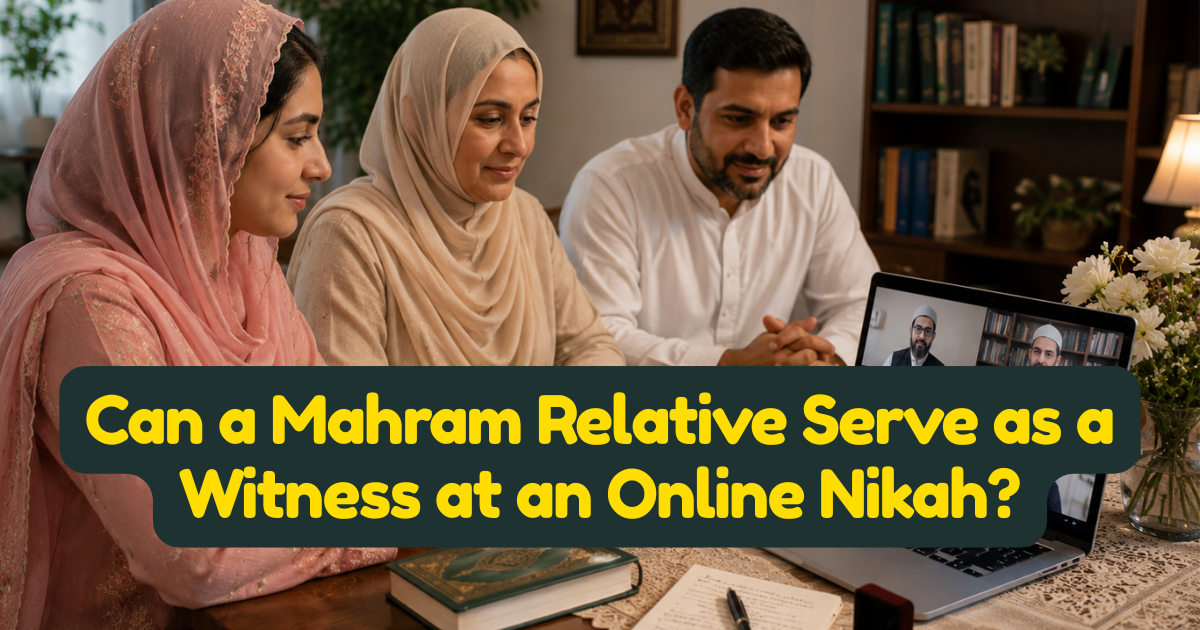
An online nikah often involves a small, carefully chosen group — the couple, the wali, two witnesses, and the officiant, sometimes all close relatives on one side or the other. That closeness is exactly what makes role conflicts easy to stumble into: asking the same person to be both the wali and a witness, or unintentionally selecting witnesses whose relationship to the bride raises a genuine point of scholarly disagreement.
Can the Wali Also Count as One of the Witnesses?
This is a genuinely disputed question, not a settled one. A detailed fiqh response confirms that the wali will suffice as one of the witnesses for the nikah according to all four madhabs — a position grounded in classical fiqh texts. Other scholarly sources take a stricter view, holding that it is not permissible for the wali to be a witness to the marriage contract of the woman under his own guardianship, even where another witness is also present. Given this genuine difference of opinion, the safer and more broadly accepted practice for an online nikah is to keep the wali's role distinct from the witness role — using two separate people for the two functions whenever the witness count allows it, rather than relying on the more disputed combined-role position.
What About a Brother, or the Bride's Father, Specifically?
A separate, related ruling clarifies the distinction between different mahram relatives. A detailed fatwa on whether a groom's father can be a witness confirms that he can, since he isn't acting as a wali in that marriage — but this same source draws a clear contrast with the bride's father, who is the wali, and notes genuine scholarly disagreement specifically about whether he can also serve as a witness in his own daughter's marriage. The bride's brother, by contrast, is treated far more straightforwardly: it is valid for a brother to be a witness to his sister's marriage, since he isn't acting as her wali himself.
The Wakeel/Witness Conflict Is More Settled
One conflict that is genuinely settled, rather than disputed, involves a wakeel (a representative standing in for the bride or groom). A clear fiqh ruling on this point confirms that a wakeel cannot also be counted as one of the witnesses at the same ceremony — since the wakeel is standing in the place of one of the two contracting parties, they fill that role, not the separate role of an independent witness. If a wakeel is involved, the ceremony needs its full two witnesses entirely separate from that person.
Practical Guidance for an Online Nikah Specifically
- Keep the wali and the two witnesses as three distinct people wherever possible, sidestepping the disputed combined-role question entirely rather than relying on the more permissive view.
- A brother is a straightforward, widely accepted choice as a witness — a genuinely useful option when family numbers on a call are limited.
- If the bride's father is also her wali, avoid also using him as one of the two witnesses, given the real scholarly disagreement on this specific combination — choose someone else for that role if at all possible.
- Never use a wakeel as one of the witnesses — this combination is invalid across the relevant fiqh sources, not merely disputed.
- If your options are genuinely limited — a small family, few people available on the call — raise the specific people involved with your officiant before the ceremony, so any role conflict is caught and resolved in advance rather than discovered afterward.
Key Takeaway
Some witness-role questions involving mahram relatives are genuinely disputed among the schools — like whether a wali can double as a witness, or whether a bride's father specifically can serve in both capacities — while others are clearly settled, like a brother being a perfectly valid witness, or a wakeel never being able to double as one. The safest approach for an online nikah, where the circle of available people is often small, is to keep roles distinct wherever you can and flag any unavoidable overlap with your officiant before the ceremony begins.
```Admin User
Author