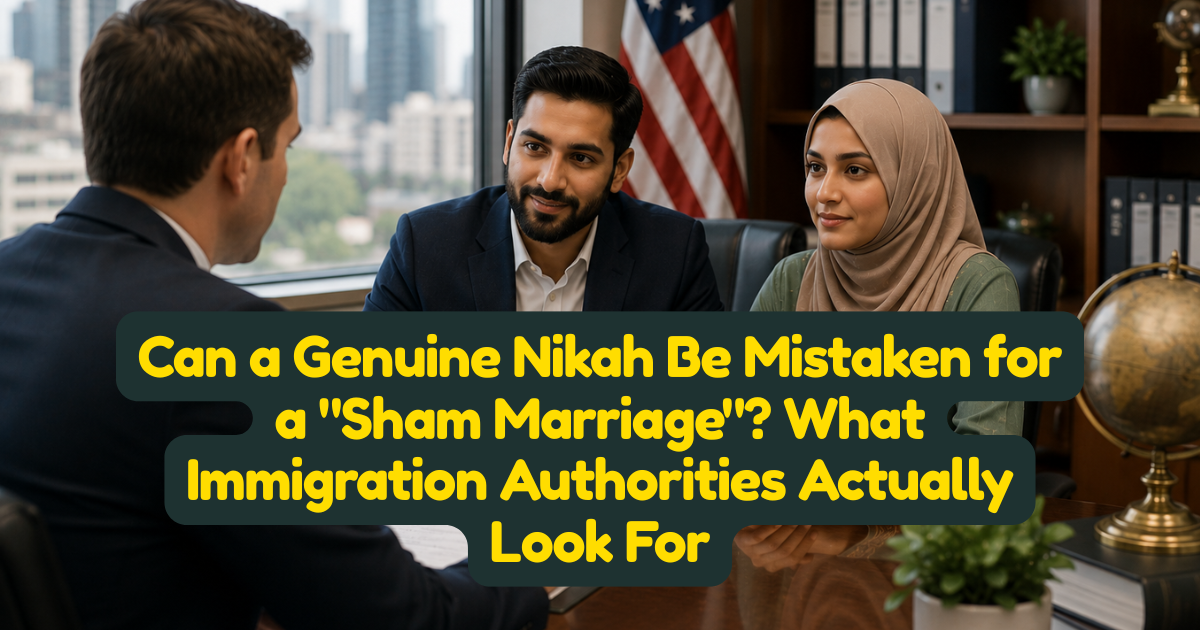
Genuine Nikah, Suspected Fraud: Why Immigration Authorities Scrutinize Cross-Border Marriages
Every year, thousands of entirely genuine Muslim marriages get extra scrutiny from immigration authorities for the same reason: short courtships, separate residences during a long-distance engagement, or a wedding that happened quickly after meeting online — all of which, fairly or not, resemble the pattern of arranged immigration fraud.
What USCIS Is Actually Checking For
Under US law, the burden sits entirely with the petitioning spouse to prove the marriage is "bona fide" — entered for a shared life, not to circumvent immigration law. According to the official USCIS Policy Manual on spousal petitions, officers evaluate joint financial records, cohabitation evidence, communication history, and consistency between each spouse's account of the relationship during separate interviews. A detailed practitioner breakdown of the specific "red flags" that trigger deeper review — separate addresses, no commingled finances, a marriage timed close to a visa expiration — is laid out by the Catholic Legal Immigration Network's analysis of USCIS marriage fraud indicators.
Long-Distance Nikahs Face Disproportionate Scrutiny
This is precisely where genuine long-distance Islamic marriages are most exposed. A couple who married via a religiously valid online or short-visit nikah, and who have not yet cohabited because of visa timing, will look — on paper — identical to a fraudulent case unless they proactively document video call history, travel records, religious ceremony documentation, and ongoing communication. An academic legal analysis of how USCIS's "Stokes interview" framework evaluates exactly this kind of evidentiary gap is available through Brooklyn Law School's law review study of immigration marriage fraud investigations.
The UK Equivalent: The Sham Marriage Referral Scheme
In the UK, the Home Office runs a parallel system under the Immigration Act 2014. According to the official Home Office statutory guidance on marriage investigations, registration officers must refer any proposed marriage involving a non-exempt national to the Home Office, which can extend the standard 28-day notice period to 70 days if it has "reasonable grounds" to suspect the marriage is a sham — defined specifically as the absence of a genuine relationship combined with an immigration motive, not simply an unconventional courtship.
How to Protect a Genuine Nikah From Misclassification
In both jurisdictions, the practical defense is the same: build the documentation trail before it's needed, not after a Request for Evidence arrives. That means keeping the marriage contract, witness affidavits, mahr receipts, communication logs, and any video record of the nikah ceremony itself — all of which double as religious documentation and as bona fide marriage evidence. Importantly, neither USCIS nor the Home Office requires cohabitation or a Western-style courtship; the standard is genuineness of intent, which an Islamically valid nikah with consistent, documented contact between spouses satisfies on its own terms.
Why InstantNikah.com Documentation Matters Here
A nikah certificate that records the ceremony date, witnesses, officiant, and mahr in clear, consistent detail becomes one of the strongest pieces of bona fide marriage evidence a long-distance couple can present — which is exactly why every InstantNikah.com certificate is built to stand up to this level of scrutiny.
Admin User
Author