Can a Nikah Renewal Be Refused by an Imam, and What Happens Next?
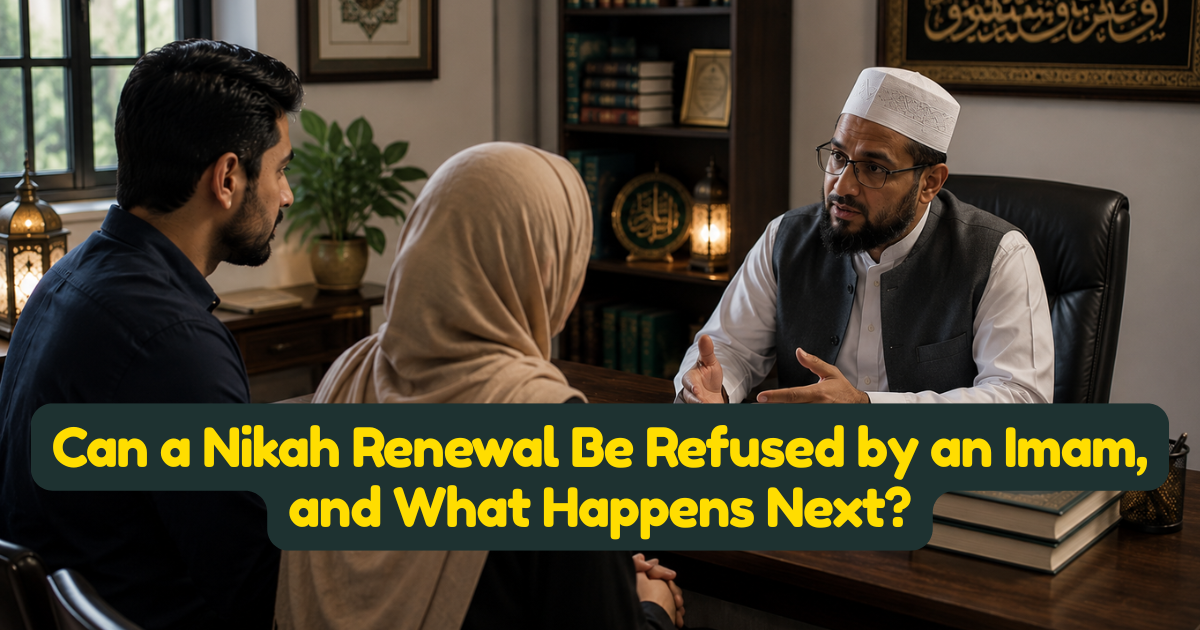
Couples occasionally arrive at a renewal consultation expecting a formality and instead hear something they did not anticipate: the officiant is not comfortable proceeding. It can feel confusing, even a little insulting, especially when the couple sees the renewal as their own private decision. But a qualified imam declining a Tajdeed e Nikah request is not arbitrary gatekeeping — it usually reflects a genuine concern the officiant is obligated to raise rather than ignore.
Reason One: Signs of Coercion
If an officiant senses, during private conversation with each spouse, that one party is being pressured into the renewal — by the other spouse, by extended family, or by any external circumstance — most responsible imams will pause the ceremony. A nikah contract, renewed or original, requires free and informed consent from both parties; proceeding despite visible coercion would produce a contract of doubtful validity, and a careful officiant will not put their name to that outcome.
Reason Two: Unresolved Talaq or Iddah Status
As covered elsewhere in this series, the correct process depends entirely on whether the couple is within a revocable iddah (requiring only ruju), past iddah (requiring a fresh contract), or dealing with a third and final talaq (requiring the classical intervening-marriage condition before any remarriage between the same two spouses can even be considered). An officiant who identifies that a couple's situation actually falls into the third category will refuse to perform a simple renewal, because doing so would not produce a religiously valid marriage regardless of both spouses' wishes.
Reason Three: Doubts About Identity or Legal Capacity
If identity verification raises concerns — mismatched documentation, uncertainty about whether either party is already validly married to someone else, or unclear legal capacity to marry — a responsible officiant will pause until those concerns are resolved, consistent with fraud-prevention standards referenced by authorities such as U.S. Citizenship and Immigration Services for any marriage intended to support an immigration file.
Reason Four: A Request That Appears Designed Solely to Manufacture Documentation
Officiants are generally cautious about renewal requests that appear to have no genuine religious or relational basis and seem oriented entirely toward producing a document for an unrelated purpose, particularly where the couple cannot credibly explain the underlying reason for wanting to renew. This does not mean immigration-motivated documentation needs are illegitimate — many are entirely genuine — but an officiant will want a coherent explanation before proceeding.
Reason Five: Unresolved Underlying Conflict
Some officiants decline to perform a renewal intended purely to paper over a serious, unaddressed marital conflict — abuse, ongoing infidelity, or a pattern the officiant believes needs counseling or mediation before any ceremony, religious or otherwise, would meaningfully help. This is more a matter of pastoral judgment than strict fiqh, and practices vary between officiants, but many will at least strongly recommend counseling alongside, or before, any renewal in these circumstances.
What a Refusal Does Not Mean
It is important for couples to understand that a refusal from one officiant is not a universal or binding religious ruling on their marriage. It reflects that particular officiant's assessment, based on the information available to them at that time. It does not mean the couple's marriage is invalid, that they are barred from ever renewing, or that something is fundamentally wrong that cannot be resolved.
What to Do If Your Renewal Request Is Declined
- Ask directly for the specific reason. A responsible officiant should be willing to explain their concern clearly rather than leaving the couple guessing.
- Address the underlying issue if one is identified. If coercion, unresolved talaq status, or documentation concerns were the trigger, resolving that specific issue — sometimes with input from a Sharia council — often clears the way for the renewal to proceed later.
- Seek a second qualified opinion. Different officiants may weigh borderline cases differently; consulting a second qualified imam or Sharia council, particularly bodies such as the Dar al-Ifta al-Misriyyah, can provide additional clarity where the first officiant's concern was genuinely a matter of interpretation rather than a clear-cut issue.
- Do not seek out an officiant willing to skip proper diligence. If the original concern was legitimate — genuine coercion, for example — finding a less careful officiant does not resolve the underlying problem; it simply produces a contract with the same doubts attached.
How InstantNikah.com Handles Cases Where We Cannot Proceed
On the rare occasion our officiants are not able to proceed with a requested renewal, we explain the specific concern directly to the couple and, where appropriate, point them toward the steps — a Sharia council consultation, resolving a documentation gap, or addressing an unresolved talaq question — that would allow the request to be reconsidered. Our goal in these situations is the couple's genuine wellbeing and a religiously sound outcome, not simply completing a transaction.
Admin User
Author