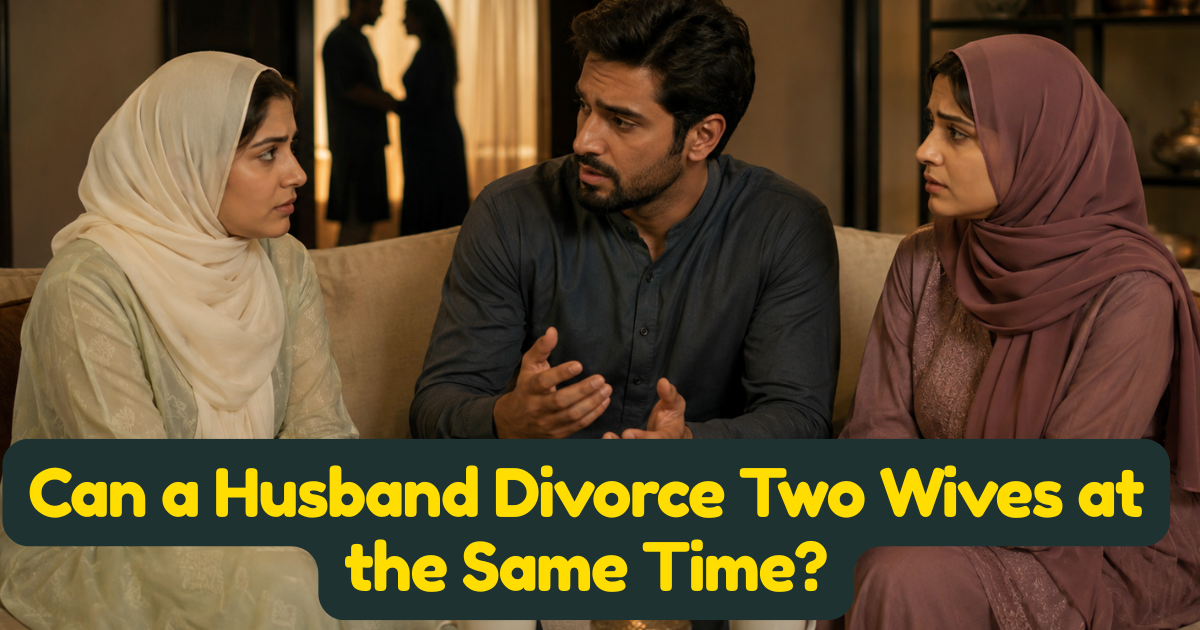
Can a Husband Divorce Two Wives at the Same Time? Islamic Ruling Explained
A man writes in from London: he has two wives, one in Birmingham and one back home, and after a hard week he tells both, in the same phone call, "I divorce you." He wants to know if that one sentence ended one marriage, both marriages, or somehow tripled the damage to either of them. It's a more common question than people expect, especially among Muslim families practicing polygyny across borders, and the confusion almost always comes from mixing it up with the unrelated controversy over triple talaq pronounced to a single wife.
Two Different Questions That Get Mixed Up
"Talaq to two wives at once" and "triple talaq to one wife" sound similar but are legally nothing alike. Triple talaq asks whether saying "talaq" three times to the same woman in one sitting counts as one divorce or three — a genuine point of disagreement among scholars, with the Hanafi, Shafi'i, and Maliki majority treating it as three, and Ibn Taymiyyah's school treating it as one. Divorcing two wives at the same time asks something structurally different: what happens when one statement is directed at two separate women, each tied to her own marriage contract. There is no comparable disagreement here, because the underlying legal mechanics are far simpler once each wife's contract is treated on its own terms.
Every Nikah Is a Standalone Contract
Islamic jurisprudence treats polygyny as a series of independent bilateral contracts, not one combined arrangement. The permission for up to four wives in Surah An-Nisa (4:3) is conditioned on the husband's ability to be just to each wife individually, which presumes each relationship carries its own rights, its own mahr, and its own legal record. The Assembly of Muslim Jurists of America's Family Code spells this out in practical terms: the limits, restrictions, and obligations that apply to a husband's fourth wife, say, are tracked entirely separately from what applies to his first. Nothing about wife number two's marriage changes because wife number one was divorced, and nothing about her talaq count, her iddah, or her mahr depends on what happens to the other wife.
This separation is the entire answer to the question. Because each marriage is its own contract, a single sentence that names both wives is not one divorce act split between them — it is two divorce acts, spoken together, each attaching fully and only to the wife it was addressed to.
So Is It Valid to Address Both Wives Together?
Yes, provided the statement clearly identifies each wife, either by name or by an unambiguous reference such as "my two wives." If a husband says, "Aisha, you are divorced, and Sana, you are divorced," classical fiqh treats this exactly as if he had turned to each woman separately and divorced her on her own. Aisha receives one talaq against her own count (she may still reconcile or remarry him later, up to her own limit of three). Sana receives one talaq against her own count, entirely unaffected by what happened to Aisha. Neither divorce is doubled, neither is voided by the other, and neither talaq count borrows from the other wife's history.
Where scholars do urge caution is specificity. Islam Question & Answer's detailed ruling on divorce wording reinforces a principle that runs through almost every fiqh discussion of talaq: vague or unclear wording creates doubt, and doubt benefits the marriage, not the divorce. If a husband says something ambiguous like "you are both divorced" without clarity on which "you" he means, or if he later claims he only intended one of them, a qualified scholar or qazi will need the exact wording to determine what actually took effect. This is also why InstantNikah always recommends that any pronouncement of talaq, like the original nikah certificate itself, be documented clearly and witnessed rather than left to memory or a heated phone call.
What Doesn't Carry Over Between the Two Wives
- Talaq count: Each wife has her own ceiling of three pronouncements before the marriage becomes irrevocable for her specifically. See our earlier breakdown of Talaq-e-Ahsan, Hasan, and Bid'ah for how that count is built.
- Iddah: Each wife begins and completes her own waiting period independently, calculated from her own menstrual cycle or pregnancy status, not from the other wife's timeline.
- Mahr: Whatever was agreed in each individual nikah contract remains owed to that wife alone; divorcing one wife creates no claim or release affecting the other's mahr.
- Reconciliation rights: A husband can revoke Aisha's divorce during her iddah while Sana's divorce, pronounced in the same breath, proceeds entirely on its own track if he chooses not to revoke hers.
Why This Differs From the Bid'ah Triple Talaq Problem
The reason triple talaq to one wife is controversial is that it compresses a process the Quran clearly intends to be gradual — Surah Al-Baqarah (2:229) describes divorce as something pronounced in stages, with room for reflection and reconciliation between each one — into a single irreversible act against a single woman. Addressing two different wives in one sentence does not compress anything for either of them individually. Each wife still receives exactly one pronouncement, with her own full iddah and her own full opportunity for reconciliation intact. There is no shortcut being taken against either woman's rights, which is precisely why this scenario does not trigger the same scholarly dispute that triple talaq does.
The Civil Law Layer for Western-Based Families
For couples in the UK, North America, or Europe, the religious answer is only half the picture. Most Western jurisdictions do not register polygamous marriages domestically in the first place, and UK Home Office guidance on polygamous and potentially polygamous marriages treats only one wife's status as recognised for immigration and residency purposes, regardless of how Islamic law views both marriages religiously. Irwin Mitchell's analysis of polygamy recognition under English law notes that a marriage celebrated abroad may be recognised for the first wife while remaining legally invisible for any subsequent one. This means a religiously valid talaq to a second wife may need entirely separate documentation, translation, and sometimes court involvement to have any standing outside the religious sphere — something families should plan for rather than discover after the fact.
The European Fatwa Council's model marriage contract addresses this gap directly by recommending that conditions around any future polygamous marriage, and the first wife's right to her own separation if it occurs, be written into the original nikah contract — precisely the kind of clause a properly drafted contract should anticipate rather than leave to a difficult phone call years later. Globally, the regulatory picture varies sharply: Musawah's comparative survey of polygamous marriage law shows that many Muslim-majority countries now require court authorisation and proof of fairness before a second marriage is even permitted, let alone before either marriage is dissolved.
Practical Guidance for Husbands and Wives in This Situation
If a husband genuinely intends to divorce both wives, the safer and more accountable route is to address each one by name, in a calm state, ideally in writing and before witnesses — the same standard recommended for any talaq, as outlined in the classical divorce categories recorded in Sahih Muslim's Book of Talaq. Each wife should independently confirm her own iddah start date, her own mahr settlement, and, where relevant to her own residency status, seek separate legal advice rather than assuming the other wife's paperwork covers her. If either wife is unsure whether a statement was actually directed at her, that ambiguity itself is grounds to pause and seek a scholarly ruling before treating the marriage as ended — consistent with our earlier guide on how Islamic divorce procedures protect a wife's certainty about her marital status.
Key Takeaway
A husband can validly pronounce talaq to two wives within the same sentence, but it is not one divorce shared between them — it is two complete, independent divorces, each governed entirely by that wife's own marriage contract, her own talaq count, her own iddah, and her own mahr. The real risk is not in the simultaneity; it is in vague wording that leaves either wife uncertain about her own status. Clear, named, witnessed pronouncements protect both women equally, regardless of how many marriages a husband is dissolving in the same conversation.
Admin User
Author