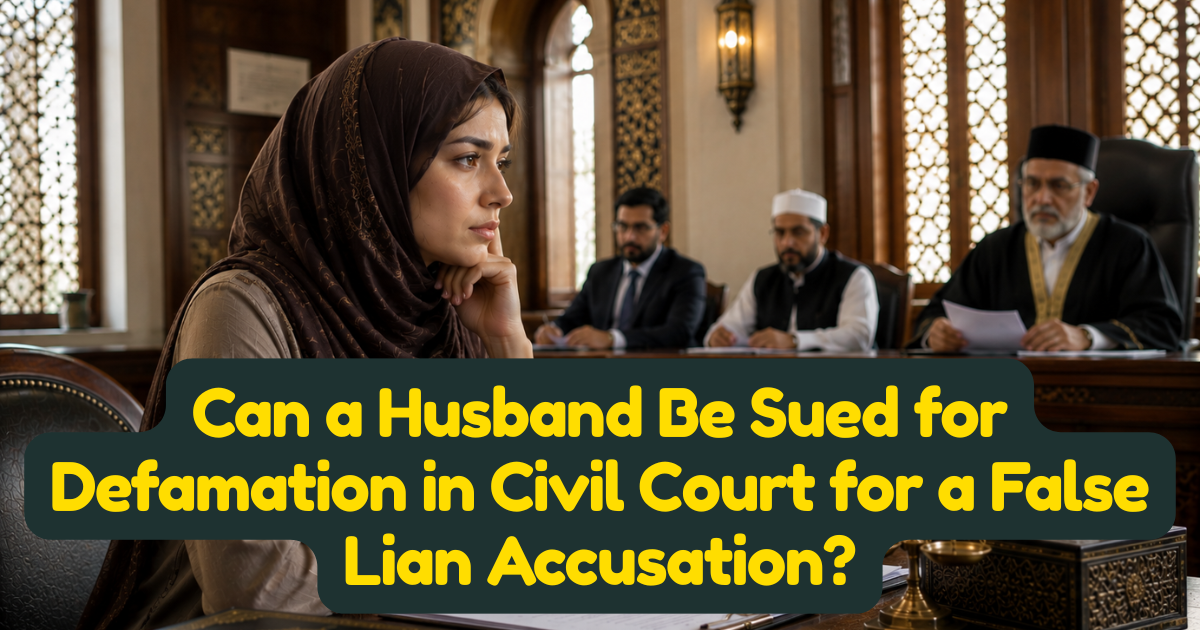
When a husband makes a false accusation of adultery through lian, the religious consequences are already serious — exposure to the punishment for slander (qadhf) if he confesses the accusation was untrue. But for a wife who has suffered genuine reputational harm, particularly where the accusation became known beyond the formal proceeding itself, a separate question arises: does ordinary civil defamation law offer any additional recourse?
False Accusations of Adultery Are a Recognised Category of Defamation
In civil law terms, this scenario fits a long-recognised category. A detailed explainer on defamation per se confirms that falsely accusing someone of sexual misconduct or unchastity falls within one of the categories courts treat as automatically harmful — meaning damages can be presumed once the statement is shown to be false and to have been communicated to a third party, without the more demanding requirement of proving specific, quantifiable financial loss. A general overview of defamation of character reinforces that false allegations of adultery or sexual misconduct can indeed form the basis of a defamation claim — though truth remains an absolute defense, meaning the entire claim depends on the accusation genuinely being false.
Where Privilege Genuinely Complicates the Picture
This is where the religious-proceeding context introduces real complexity. A detailed discussion of defamation in divorce and domestic violence cases notes a general principle that certain statements, even if defamatory, are considered "privileged" and therefore can't form the basis of a successful claim — including statements made within the context of legitimate proceedings or investigations. Whether this privilege actually extends to statements made within a Sharia council's lian process specifically is a genuinely unsettled question, since these bodies generally lack formal legal recognition as judicial proceedings under civil law. This means the answer likely depends heavily on the specific jurisdiction, whether the accusation was confined strictly to the religious proceeding itself, and whether it was additionally repeated or communicated outside that context.
Where the Accusation Spreads Beyond the Formal Proceeding
The privilege question becomes much less protective for a husband the moment the accusation travels beyond the formal lian process — told to extended family, shared within the wider community, or repeated outside the proceeding itself. Communications made specifically within a privileged context generally don't extend that same protection to repetitions made elsewhere, which means a husband who confines his accusation strictly to the formal religious proceeding sits in a meaningfully different legal position than one who repeats it more broadly afterward.
Why Pursuing Both Isn't Automatically Redundant
- Religious consequences (qadhf liability) and civil defamation liability are entirely separate systems — one doesn't substitute for or preclude the other.
- Civil defamation can address harm a religious ruling alone cannot — specifically, financial compensation for genuine reputational and emotional harm, which religious consequences don't provide directly to the wronged party.
- The strength of any civil claim depends heavily on whether and how widely the accusation spread beyond the religious proceeding itself, not simply on whether it was made at all.
- This is genuinely specialist legal territory — the intersection of religious proceeding privilege and civil defamation law is not something to assess without a lawyer experienced in exactly this kind of cross-jurisdictional question.
Key Takeaway
A false accusation of adultery generally falls within a recognised category of civil defamation, and a husband who makes one through lian isn't automatically shielded from civil consequences simply because the accusation occurred within a religious proceeding — though privilege protecting statements made in legitimate proceedings is a genuine complicating factor, and one that depends heavily on specific jurisdiction and whether the accusation spread beyond the formal process itself. A wife facing genuine reputational harm from a false lian accusation has real reason to seek specialist legal advice on whether a civil claim is viable, since the religious and civil consequences operate on entirely separate tracks rather than one substituting for the other.
```Admin User
Author