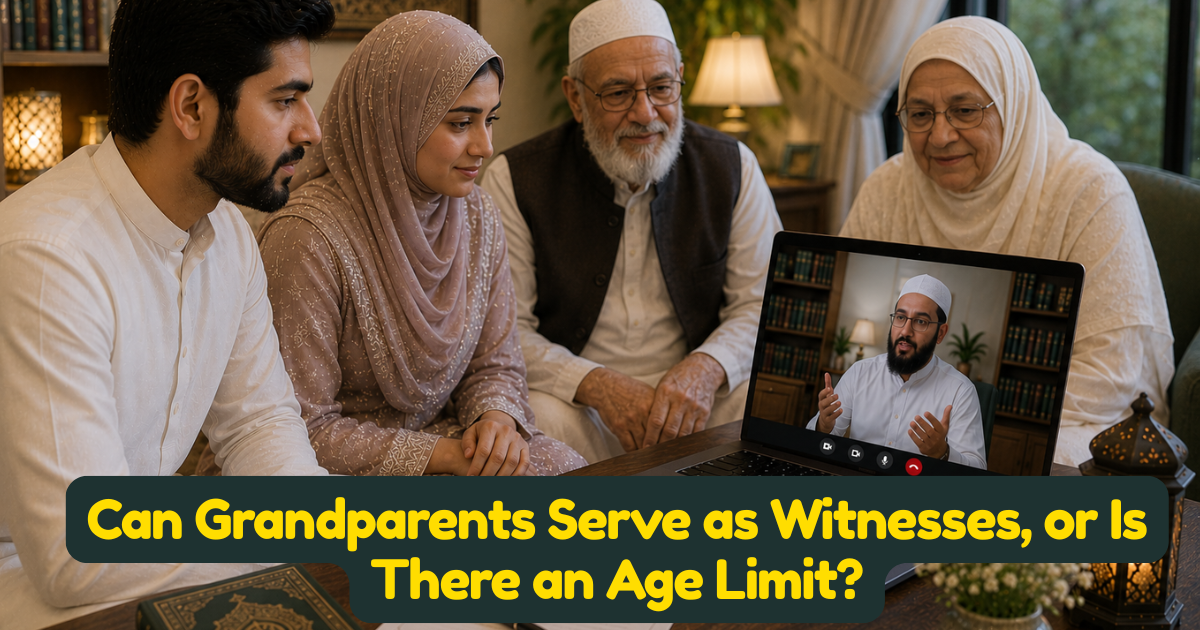
Can Grandparents Serve as Witnesses, or Is There an Age Limit?
There's something meaningful about having a grandparent present as a formal witness to your nikah — a tangible link between generations, especially for couples whose grandparents played a significant role in their upbringing or faith. It's a common and touching request, and the good news is that age, on its own, is rarely the deciding factor in whether a grandparent can serve in this role.
What Actually Determines Witness Eligibility
The classical qualifications for a valid witness center on being of sound mind (aql), generally being a practicing or believing Muslim, and having the capacity to observe and later, if needed, testify to what occurred. There is no specific maximum age cap in Islamic law that disqualifies someone purely for being elderly — what matters is mental capacity and genuine ability to understand and later recall the event, not a person's number of years.
Why Sound Mind Is the Real Consideration, Not Age
A grandparent in their seventies, eighties, or beyond, who is mentally sharp, alert, and fully capable of understanding what's happening during the ceremony, is just as qualified to serve as a witness as anyone else. The concern only arises where age has genuinely affected cognitive capacity — significant memory impairment, dementia, or a condition that would prevent someone from reliably understanding and later recalling the event — and even then, this is a matter of individual capacity assessment, not an automatic disqualification tied to a specific age threshold.
How to Assess This Sensitively
If there's genuine uncertainty about whether an elderly family member's cognitive state allows them to fully understand and meaningfully participate as a witness, this is worth discussing honestly and sensitively within the family, rather than either automatically excluding them out of an unfounded age assumption or including them without genuine confidence in their capacity to serve the role properly.
Practical Accommodations for Elderly Witnesses
For a grandparent joining an online ceremony, some practical accommodations can help ensure full participation: a family member helping with the technology setup, ensuring the volume and screen visibility are comfortable for any hearing or vision considerations, and allowing extra time if needed for the elderly witness to settle in and follow the proceedings clearly.
Is There a Minimum Age for a Witness?
On the other end, the mainstream position generally requires witnesses to have reached puberty (bulugh) — the same threshold that marks religious accountability more broadly — since full legal capacity to bear witness is tied to this stage of maturity, not simply chronological childhood versus adulthood in a Western legal sense. A grandparent, by definition, comfortably exceeds any minimum age consideration; the question for elderly witnesses is only ever about capacity, never a maximum threshold.
Grandparents Serving as Wali
It's worth noting that a grandparent can also serve in the wali role, not just as a witness, particularly a paternal grandfather where the father is unavailable or has passed away, as covered in our guide on wali succession — the same capacity considerations apply here as well.
Honoring a Grandparent's Role Beyond the Formal Witness Function
Even where a grandparent isn't formally serving as one of the two required witnesses, couples can still meaningfully include them in the ceremony — a blessing, a moment of du'a, or simply their presence on the call — allowing their significance to the couple to be honored regardless of the specific formal role they play.
How InstantNikah.com Accommodates Family Witnesses of Any Age
We welcome grandparents and other elderly family members serving as witnesses, ensuring the video call setup accounts for any accessibility needs, and discussing capacity considerations sensitively with the family in the rare cases where genuine concern exists, rather than applying any blanket age-based exclusion.
Admin User
Author