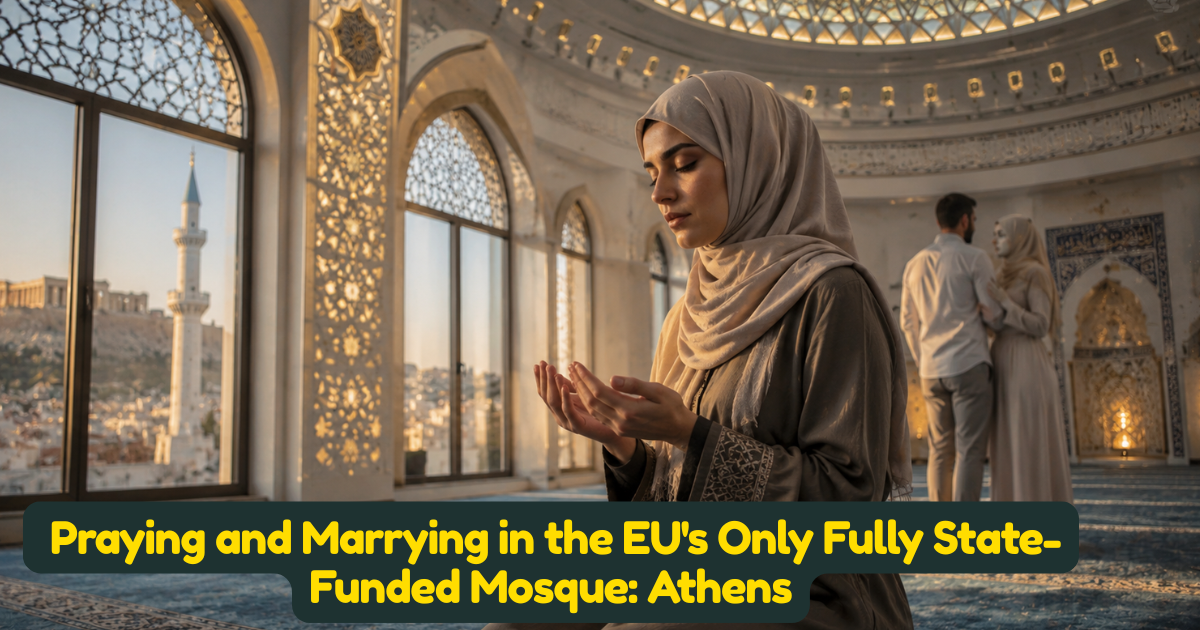
Praying and Marrying in the EU's Only Fully State-Funded Mosque: Athens
This site's Western Thrace page covers Greece's remarkable, government-recognized Sharia jurisdiction along the Turkish border. Athens itself tells an almost entirely different story — one about the capital city having no mosque at all, for nearly two centuries, despite hosting one of the largest Muslim populations of any European capital.
187 Years Without a Mosque
Athens had no dedicated, purpose-built Muslim place of worship from the moment Greek forces expelled occupying Ottoman troops in 1833 until November 2020 — a gap of 187 years. The Greek Parliament's first legislative attempt to build one came as early as 1890. Further attempts followed in 1934, in 1970 with an offer of funding from Gulf states that went nowhere, and again in 2000 and 2004 — each one stalling under objections from the Greek Orthodox Church and nationalist opposition, who frequently framed Islam as tied to memories of Ottoman occupation. In the meantime, Athens's genuinely large Muslim population — estimated at anywhere between 200,000 and 500,000 people, including significant Pakistani, Bangladeshi, Afghan, Syrian, and North African communities — was left praying in dozens of unpermitted, makeshift spaces: basements, garages, converted parking lots.
A Uniquely State-Controlled Solution
When Athens's mosque finally opened its doors on November 3, 2020, after Parliament had approved the project back in 2006 and construction survived 14 more years of bureaucratic delays, far-right protests, and legal challenges, it arrived with a genuinely unusual structure: Greek officials themselves describe it as the only fully state-funded, state-run mosque anywhere in the European Union. The building, a plain beige structure with no minaret or dome due to local permit restrictions, sits in the Eleonas industrial district near a refugee camp, operates under a sign reading "Hellenic Republic Ministry of Education and Religious Affairs Mosque of Athens," and is staffed by Zaki Mohammed, a state-appointed imam and Greek citizen of Moroccan origin — with a permanent 24-hour police guard.
A Story That Isn't Fully Resolved
This is worth being honest about: the Athens mosque's opening didn't settle the broader question of Muslim worship space in the capital. Since 2012, Greek authorities have enforced a previously dormant 1936 law requiring all places of worship to hold a government permit — of roughly 90 informal mosques operating across Athens, only about 10 to 13 have successfully obtained permission to continue, while at least 15 have been closed, some Muslim community leaders describe this bureaucratic tightening as a deliberate strategy rather than neutral enforcement.
A Genuine Legal Update Worth Knowing
This connects directly to the story covered on this site's Western Thrace page: in 2018, Greek law was changed so that application of Sharia jurisdiction for the recognized Muslim minority's family matters — including marriage — became optional, requiring both parties' explicit consent, rather than compulsory as it had been for nearly a century beforehand.
Where an Online Nikah Fits
Given how limited and closely government-managed Athens's own mosque infrastructure remains, an online nikah offers genuine, practical value for the capital's large and diverse Muslim community. The underlying religious requirements stay the same as anywhere else: a clear offer and acceptance, the wali's role, two qualifying witnesses, and an agreed, documented mahr, paired with the standard Greek civil marriage process that applies outside Western Thrace's specific jurisdiction.
Who This Tends to Fit in Athens
- Couples navigating Athens's limited, closely regulated mosque infrastructure.
- Pakistani, Bangladeshi, Afghan, Syrian, and North African Muslim families across the capital.
- Couples who've completed their Greek civil marriage and want a properly documented religious ceremony to follow.
- Couples who want a documented, recorded ceremony independent of the capital's still-limited official infrastructure.
Frequently Asked Questions
Is Athens's mosque really the only one of its kind in the EU?
According to Greek officials, yes — it's described as the only fully state-funded, state-run mosque anywhere in the European Union.
Are Athens's other, unofficial mosques legal?
Most aren't currently permitted — only around 10 to 13 of roughly 90 informal mosques have obtained official government permission, with others closed.
Is this the same legal system as Western Thrace's Mufti jurisdiction?
No — Athens operates under standard Greek civil marriage law; Western Thrace's distinct Sharia jurisdiction, covered elsewhere on this site, applies specifically to its own recognized Muslim minority.
Authority References Used (Live & Clickable)
- Al Jazeera — reporting on the 2020 opening of Athens's first official mosque after 14 years of delays
- Hyphen — in-depth reporting on the state-run structure of the Athens mosque and permit restrictions on informal mosques
Suggested Internal Links
- Nikah Contracts With Real Legal Force: Western Thrace, Greece
- Documents Needed Before Booking an Online Nikah
- Is Online Nikah Legal? A Country-by-Country Guide
- What Makes a Nikah Certificate Islamically and Legally Valid?
- Book Your Online Nikah
Why This Article Is Different
This page deliberately distinguishes Athens's story from the Western Thrace piece already published on this site — a capital-city mosque desert lasting nearly two centuries, solved through a uniquely state-controlled arrangement — while linking the two through a real, current 2018 legal update, giving readers of both pages a fuller, non-redundant picture of Greece's genuinely complex relationship with Islam.
Zainab Butt
Author